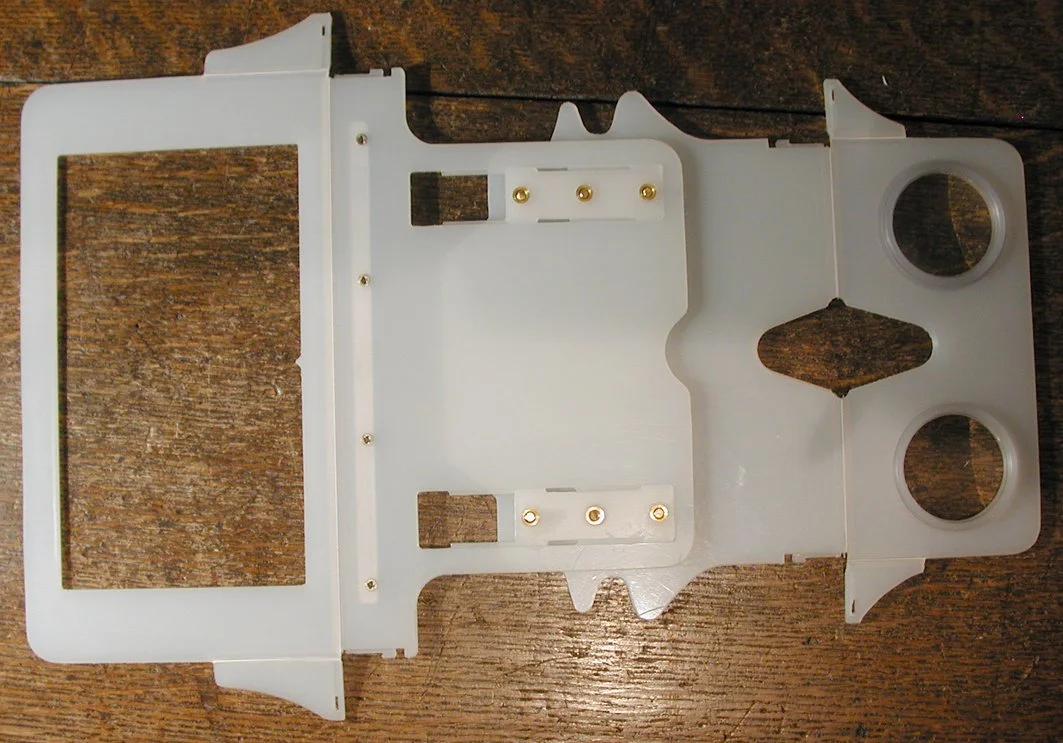
OWL Stereoscopic Viewer

Brief
In 2009 Westons were approached by Queen guitarist Brian May who planned to publish a book on the stereoscopic photographs of TR Williams. It was proposed that the book would reproduce Williams’ stereoscopic series ‘Scenes In Our Village’, and so would require a flat packing plastic stereoscope included with the book to enable the reader to view the pictures in 3D.
Brian had been unable to source a stereoscopic viewer that he was happy with, and so came to Westons with the intention of putting his own viewer design into production.
Having already produced card prototypes, Brian had a firm idea of what he wanted from his viewer, what he did not know was exactly how the injection moulding process would work for the design, what the benifits and pitfalls would be, and what considerations would need to be taken into account in order that the injection moulding manufacturing process would be successful.
CAD Component Design
We began the project working closely with Brian and co-author Elena Vidal to develop what became the OWL viewer, modeling it using CAD software and eventually resolving the design as a two piece polypropylene moulding with snap fit lenses to be inserted at the time of manufacture.

Prototypes
The development stage involved several prototypes. The most important being a polypropylene model with fully functioning hinges (of which there were 6), runners and snap in lenses. This prototype model was CNC machined from sheet polypropylene on our Hurco, giving a very accurate indication of how the final moulded version would behave.

Tooling
The design was approved from the prototypes and on Brian’s request we began tooling here in the UK in our onsite workshop.

The fixed half core insert plate set up on our Bridgeport Milling machine for the drilling of ejector pin holes.

An eyepeice core showing the tracks created by the CNC milling program.

Spark Erosion of an eyepiece core. A copper electrode is lowered onto the steel and an electrical current passed through it. The result is perfect erosion in the form of the copper electrode.

The OWL tool features two laser cut inserts. The London Stereoscopic Company Logo was cut from CAD files supplied by Brian which used the original London Stereoscopic Company artwork.

Brian May, Elena Vidal and Reid Weston viewing test mouldings.
5 mould trials occoured before production took place. The tool was designed with certain tolerances in place which were tweaked minutely to perfect the stiffness of all of the clips, the runners and the snap in lens fit.

Elena Vidal, Brian May and Tony Weston reviewing test mouldings.

Brian May, Elena Vidal and Chris Dodman with the final book and viewer.
Manufacturing
Brian requested that the material colour should change during the run and so 15 different colour masterbatches were mixed into the virgin material sequentially. All mouldings were used including the ones produced as one colours mixed into another. It took S.B.Weston only a few days to manufacture and assemble the 8.8k multicoloured viewers for the books initial run.
Conclusion
The OWL Stereoscopic Viewer project came to a successful conclusion for S.B.Weston Ltd as we despatched the 8.8k mouldings for packaging into the book slipcase having met our deadline. The most important aspect being that Brian was very happy with the final product, which is now getting very good reviews – the book is still in the Independent top ten book list a month after release.
Tags: Brian May, Cad Cam Tooling, CAD Component Design, Injection Moulding, Polypropylene, Stereoscopic Viewer

NATURAL VIEWING OF STEREO PICTURES
After listening to Brian’s interview on Radio 4, I assume that the NATURAL viewing he referred to, means that the eyes do not need to be crossed for a 3D effect. This is commonly done for viewing without a stereoscope. So the pictures are presumably not swapped left/right. This means that the images would be restricted in size to fit the interpupilar distance of approx 6cm. AM I CORRECT? Also the use of lenses mean that the eyes are focussed at long distance to match the image, which leads to NATURAL focussing. Comments please. Brian Farley
Hello Brian, thanks for your comment,
The stereoscopic pairs printed in Brian’s book are arranged for parallel viewing through the OWL Stereoscope where the right eye looks at the right image. I believe that the ‘Natural’ viewing that Brian was refering to is, as you say, viewing the images in parallel and not ‘cross eyed’ where the right eye looks at the left image etc. There is more information on viewing techniques in the book, and also on producing your own stereo images.
I think you will find that the best 3D effect by far occours when you use the OWL Stereoscope!
cheers
Chris.
I am working on poducing a template to allow anyone to produce stereo pictures using any digital camera. The Owl viewer is absolutely perfect for this and I am sure there will be many people using the viewers in the future. Can they be bought without buying the book I wonder?
Hello, thanks for your comment.
In answer to your question, yes! the OWL Viewer can be bought from the London Stereoscopic website as an individual item.
Follow this link http://www.londonstereo.com/shop_home3.html
Please keep us updated with regards to your template!
Many thanks.
The Weston’s team.
I’ve shared you article on digg, well written